L·01
Copy-move duplication
Duplicated, rotated or scaled regions found across a paper’s panels.
A multi-layer forensic pipeline and an AI verification layer examine any figure or full-paper PDF, then deliver an evidence report worthy of the permanent record — emailed and kept in your dashboard.


The real pixel-forensics detector runs right here, on one image — no account, no card. Whole-PDF scanning, cross-figure reuse and the AI checks are a free signup away.
No spinner to watch — the report comes to you by email and is kept on your shelf.
Image or full PDF. Every panel is segmented and gel and blot lanes are aligned automatically.
Copy-move, splice, noise and plot layers run in parallel, fused into ranked findings — each confirmed by AI verification.
A labeled report — shareable, exportable as PDF, and kept in your dashboard for the record.
Duplicated, rotated or scaled regions found across a paper’s panels.
Lane-aware band matching and noise-boundary analysis catch spliced gels.
Impossible error bars, duplicated points and fabricated trends.
Confirms each flag and writes a plain-language verdict for editors.
Detects panels duplicated across different figures in the same paper.
Compare code to sources; flag invalid refs and AI-generated text.
A single API plugs G.O.A.T Peer into your submission system — every manuscript screened at intake, the report posted back automatically.
Async submission with a webhook callback — no reviewer lifting required.
JSON plus a human-readable PDF per submission, with configurable flag thresholds.
Flagged manuscripts route to your integrity desk; SSO, audit log and data residency.
Not a score in a vacuum — the matched regions, the flicker that makes a duplicate undeniable, and the line-by-line token trail behind a plagiarism call.
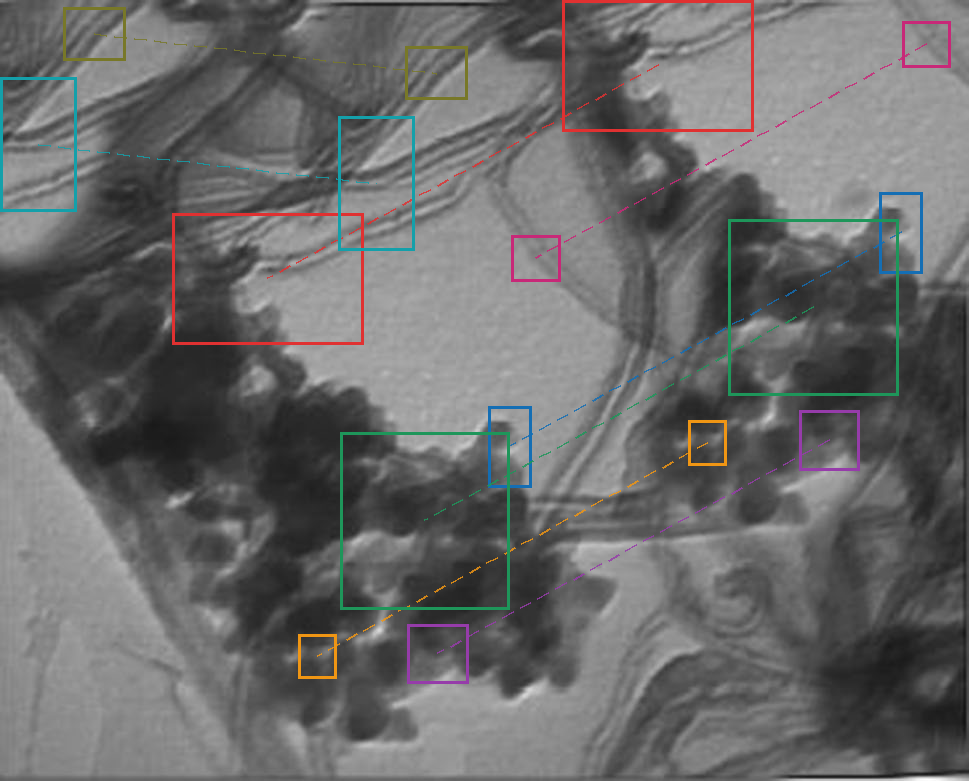
Duplicated regions are boxed, colour-paired and joined, so you see at a glance which panel was reused where — each with a likelihood you can filter on.
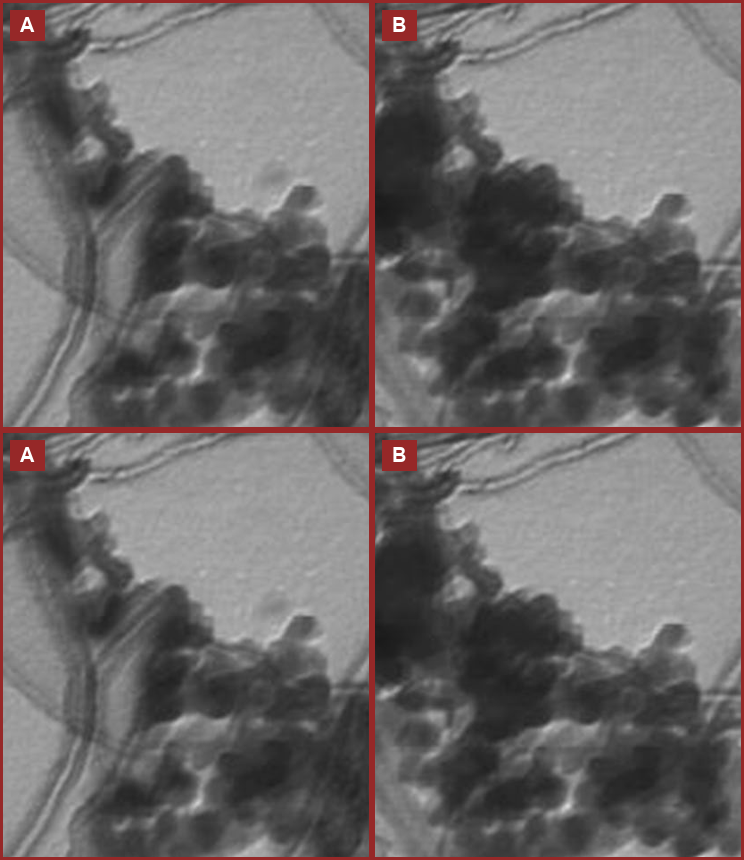
The two matched regions, aligned and flicked back and forth. The particles don’t move — it’s the same field of particles copied to two places in the figure.
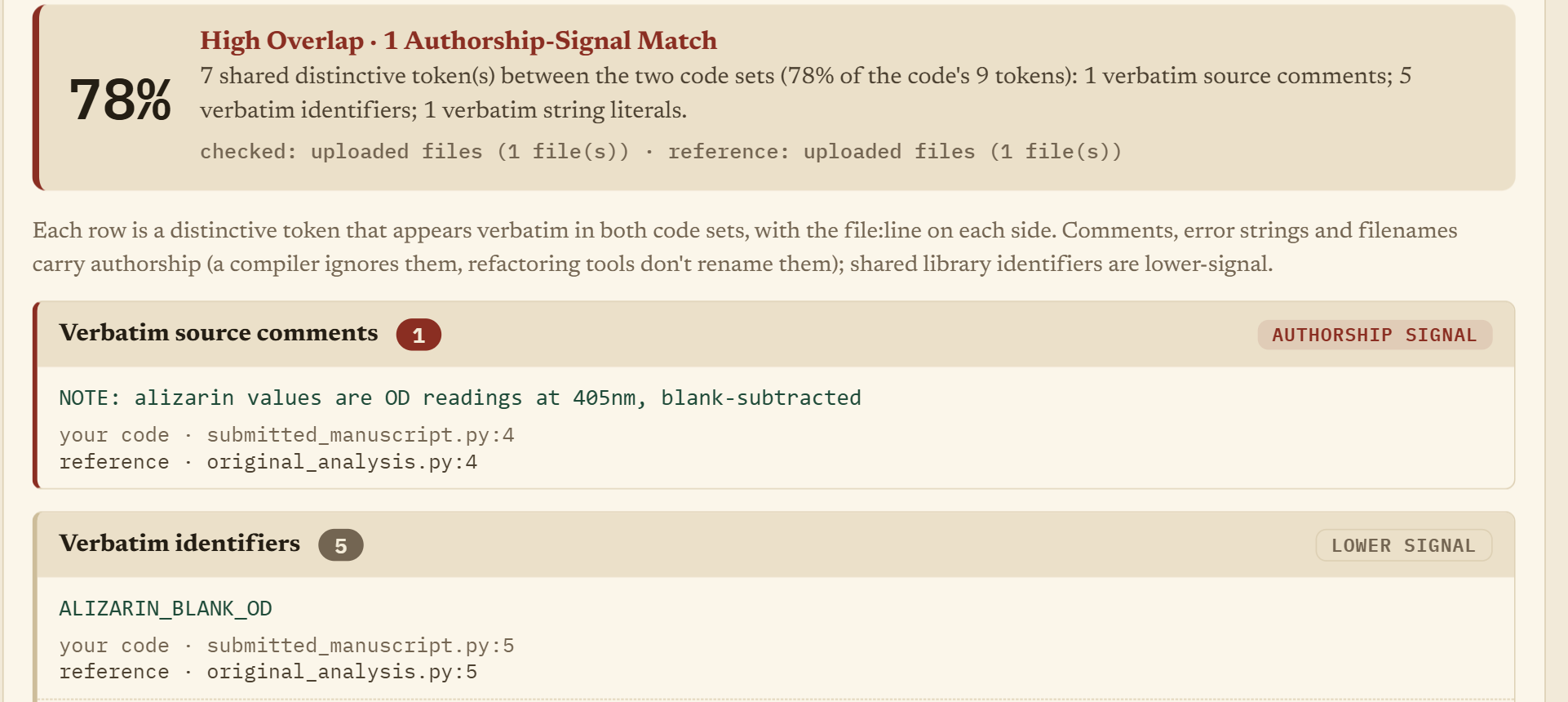
Compare a paper’s code against any reference — scripts, a .zip, or a GitHub link. Renaming the functions doesn’t help: the verbatim comment and the copied error string still carry authorship, and every match is shown with its file and line on both sides.
Every plan runs the same forensic engine. What changes is how much of it you point at a paper.
Alpine is free and runs the whole forensic detector — figures or full-paper PDFs, every check that works on the images themselves. Mountain adds the AI layer: it verifies each flag to strip false positives, reads the article text, and checks the code and the references.
It verifies each flag to strip false positives, reads the article text for integrity problems (including circular reasoning and study-design flaws), and checks the code and the references. The forensic detection itself — every check on the figures — is on Alpine too.
One paper, put through the full Mountain analysis — every figure, every AI check — for $15, with no subscription. Useful when you have a single manuscript in front of you rather than a steady stream.
No. Your uploads are never used to train models, and they're deleted on request. Enterprise adds on-premise deployment and explicit data-retention controls if that has to be contractual.
A duplicated panel caught in review costs an afternoon.
The same panel caught after publication costs the paper.
Alpine is free. Mountain is $49.99 a month, or $15 for a single scan. The report comes to you.
Analyze a paper